Sunday, 7 April 2013

Thoughts on 'A Life in Jewellery' Exhibition


swansf
The Swan collection on display 
Welcome to ‘A Life in Jewellery’
This exhibition runs from 26th March – 28th April at the Somerset Crafts Centre, Avalon Marshes.
I hope that visitors enjoy exploring my work.
The title of the exhibition has been chosen as it has two meanings for me. Firstly it represents my working life (27 years) of professional jewellery making and designing. Secondly, I strive to encapsulate a ‘life’, story and meaning within every piece of my work – whether it’s part of my collections or one-off commissions.

Kerensa pendant in hand painted box

The Mine Beneath the Sea


Somerset Crafts, a group of dedicated professional Somerset artists and craftsmen, have established a close working relationship with Natural England who own the site of their craft centre and gallery at the Avalon Marshes, Shapwick Heath – one of Britain’s most valued nature reserves and a special jewel in Somerset’s crown. Twenty Percent of every sale is given to Natural England to support them in their valuable work in helping maintain the natural environment that is at the core of the artist’s work and inspiration.


Follow Erica on Twitter: https://twitter.com/EricaSharpe
Visit Erica's Website: http://www.ericasharpe.co.uk


Monday, 11 March 2013

5 Minutes with… Erica Sharpe: Make Jewellery Magazine Interview April 2013

Make Jewellery Magazine talks to jeweller, Erica Sharpe, about her delicate creations and the design process in their April 2013 issue.


Young Artist

Since I was a small child I have always been making things, drawing and painting, so a career in the arts was always on the cards. During my art foundation course I was introduced to jewellery making. I felt an instant connection with working in metal and the fusion of art, design and technical craft; sculpture in miniature.

Fair Play

I think ethical jewellery production is extremely important. I was one of the first jewellers worldwide to receive a licence to sell pieces from Fairtrade and Fairmined gold.  As a jeweller I have a responsibility to ensure my items, which are often bestowed with great meaning and sentiment, are created in a fair way which has not caused suffering. Jewellery should make the wearer, giver and maker feel special
Stella triple flower ring


Work Ethic

After art college, I got an apprenticeship making traditional Indian jewellery and I am very grateful for the culture and work ethic I was introduced to. Following that, I worked making fine jewellery and have been very fortunate to have worked for some brilliant master jewellers. I studied granulation and micro-wire work with the Italian jeweller Giovanni Corvaja and also qualified as a gemmologist with Gem A.  My designing has been helped by drawing tuition with illustrator Cliff Wright, and painting with watercolour artist Jake Winkle. I was given the confidence to launch my own jewellery workshop by Michael Page, a master jeweller who I had been trained by.

Swan sketches
Platinum and diamond swan ring

Family Support

My father is a zoologist, and mother a botanist – so as a child I was immersed in the natural (and scientific) world. However, my father came from an engineering background and was keen to pass on technical skills. My mother came from a family of craft workers, mainly cabinet makers. She created beautiful botanical illustrations and taught me patience and to observe things in detail. More than anything else, my parents supplied materials and allowed me to make a mess!  My mother kept the first piece of jewellery that I made when I was about 5 years old – a raisin threaded onto a piece of string! She must have had a feeling of things to come.

Combining Skills

I love the blend of art, design and technical skill with beautiful and rare raw materials that comes from making jewellery, and the creation of something so personal with meaning and a story. I combine my jewellery with sculpture, sketches and painting. I’ve always found so many aspects within the jewellery world to study and explore and enjoy passing this on to the next generation – I really can’t imagine doing anything else!
Watercolour

Coastal Inspiration

The natural world has always been close to my heart. My Kerensa collection features textured gold and silver inlaid with Cornish tin. The designs are inspired by the dramatic and beautiful coast which is the source of the the tin. I also walk daily in the Somerset countryside and enjoy seeing the changing landscape and wildlife. A small observation, for example the flight of a swallow, is enough to get me thinking up designs for jewellery.
22ct gold Ocean pendant 


Follow Erica on Twitter: https://twitter.com/EricaSharpe
Visit Erica's Website: http://www.ericasharpe.co.uk

Friday, 8 March 2013

Making a Bespoke Engagement Ring

This commission was for a surprise engagement ring.

feature
The chosen design

Two brilliant-cut diamonds had been chosen by my customer to use for the ring; one of just under a carat in weight and the other one smaller but of the same exceptionally high quality.
My customer provided me with some images of styles that his partner liked (clothes, favorite jewellery colours etc) and from this I created several mood-boards with design elements and ideas that might suit the double stone ring. The ring is to be part of three in total – a wedding and eternity ring to be added later. With this in mind, simplicity in form was an important consideration so as to allow the other rings to interlock.


One of the mood boards I created to discuss the initial styles for the ring


Platinum was chosen to make the ring and the unusual split-claws added the element of the number eight to the design, which is of special significance to the couple’s relationship.
A natural, organic and flowing form was preferred, yet the design needed to be classical and timeless. I finalised the design and painted it to scale before getting approval and going ahead with making.

The final design

The platinum shank ready to be formed into a ring and forged 


I made the tapered knife-edge shank by forging it to the required shape. The settings were made from platinum wires to create the claws which I then soldered onto support bezels.
 Platinum has a very high melting point so requires special eye protection to shield the glare from the hot metal during soldering and welding. Contamination from many normal workshop tools (iron and steel) and chemicals has to be prevented. It is also very time consuming to polish, as the surface of the metal does not flow in the same way as gold and silver. Despite this, however, it is one of my favorite metals to work with because of the results I can achieve with it. Its strength allows very fine details to be constructed, stone settings are very durable and a good white colour, and its enduring polish gives work a beautiful finish.
The tapered knife-edge shank and claws


The finished ring. After hallmarking I set the diamonds and gave the piece a final polish


"Dear Erica,
....I said YES! Thank you very much for making such a beautiful ring. I'm so pleased with it and cannot wait for the next two to complete my set!" - The Future Mrs Thompson.


Follow Erica on Twitter: https://twitter.com/EricaSharpe

Thursday, 11 October 2012

Bird and Bough Necklace Commission


main-bird-bough

I recently completed a commission for illustrator Carol Tratt. The piece was a gift for her birthday and my brief was to design something that she could wear for special occasions, suitable for work-related dinners and events. The ideal design would look like she was wearing one of her illustrations!
After meeting with Carol and her husband, I took away some copies of her work to help me with the design. The scrolling bough and leaf designs and also the swags of hearts, moons and stars, feature frequently in Carol’s work, so I produced design ideas based on these. The bird gave the focal point in the centre panel of the necklace.
Moons and stars feature frequently in Carol's work

It felt it was very important to make sure that the finished necklace worked in 3 dimensions rather than the 2 dimensional style it was based on. To this end, I created the scrolls from forged bar and cut each leaf out individually, shaped and curled them, and soldered them in position.
I pierced out the little bird from silver sheet, filed the details on the tail to give contours and cut the wing from a separate piece and soldered it on.

To lift the design further, I cut yellow gold details such as stars, crescent moons and hearts and added them to the front with articulated rings. Their movement brings the piece to life when it is worn. They are highly polished in contrast to the frosted silver – this helps add definition, interest and makes the difference in colour more pronounced.
The beaded part of the necklace was made up of the elements from Carol’s swag designs. Again, I chose to mix polished yellow gold with frosted silver. The shaped beads are threaded onto a strong silver chain and I added an adjustable length fastener at the back.
The finished piece detail with gold moons, stars and hearts

Carol wearing the finished necklace

Carol commented that “My husband, Peter, and I have always loved Erica's work, so you can imagine how excited I was when he handed me a box on my birthday tied up with Erica's ribbon. I was overwhelmed when I lifted the lid to discover the most beautiful necklace I had ever seen. Erica created the design using key elements from my illustration work which has made the necklace extremely personal. Although I knew about the necklace before my birthday, as Peter had wanted me to have some input, I was not prepared for how beautifully and creatively Erica had interpreted our ideas. I will treasure this necklace forever.”


Follow Erica on Twitter: https://twitter.com/EricaSharpe

Wednesday, 18 July 2012

The Mine Beneath the Sea

In April this year, to further my work with precious metals and Cornish tin, I undertook an artists residency on the dramatic and beautiful West Cornish coast – the area which is the source of my tin and inspiration.

As a result of spending time in and around the mines, my work entitled ‘The Mine Beneath the Sea’ was formed. It will be exhibited for the first time in the Best of the Best section at Art in Action.

The Levant tin and copper mine ran out over a mile beneath the sea, and to depths of 600 meters. Miners were able to hear the waves crashing and the sea rolling boulders and rocks above them when they were working.

On October 20th 1919, the miners were making their way to the surface at the end of their shift, when the antiquated and poorly maintained ‘man engine’ they were being transported on broke. 31 miners were killed and the operation to rescue survivors took five days.

Raw materials for 'Mine Beneath the Sea'

Making the chain for the piece

I crafted the wire wave sculpture (which can also be worn as a cuff) from recycled silver. During my residency I spent a lot of time with the sea on that coast – it was stormy and I took to ‘drawing’ the wave shapes with wire, it was a more immediate way of capturing their energy than pencil and paper (and it didn’t matter if it got wet!).

Hanging from the wave is a chain necklace entitled ‘The Edge of the World’. To make the chain, I alloyed Fairtrade & Fairmined 18ct red gold – the red colour reflects the red of the rock and mud from the mine. There are 31 links, in memory of each of the miners who lost their lives. I forged the shapes from square wire and added a simple loop at each end to link them. The necklace falls inside the plinth where, at the base, is a Kerensa Surf pendant of silver and Cornish tin. In presenting the necklace in this way I hope to portray a little of how it feels to stand at the top of a mine shaft.

Mine-Beneath-Sea-finished
The Finished Product


Find out more about my Cornish inspiration by visiting my 'Diary from the Tinner's Coast' blog: http://www.ericasharpetinnerscoast.blogspot.co.uk

Saturday, 19 May 2012

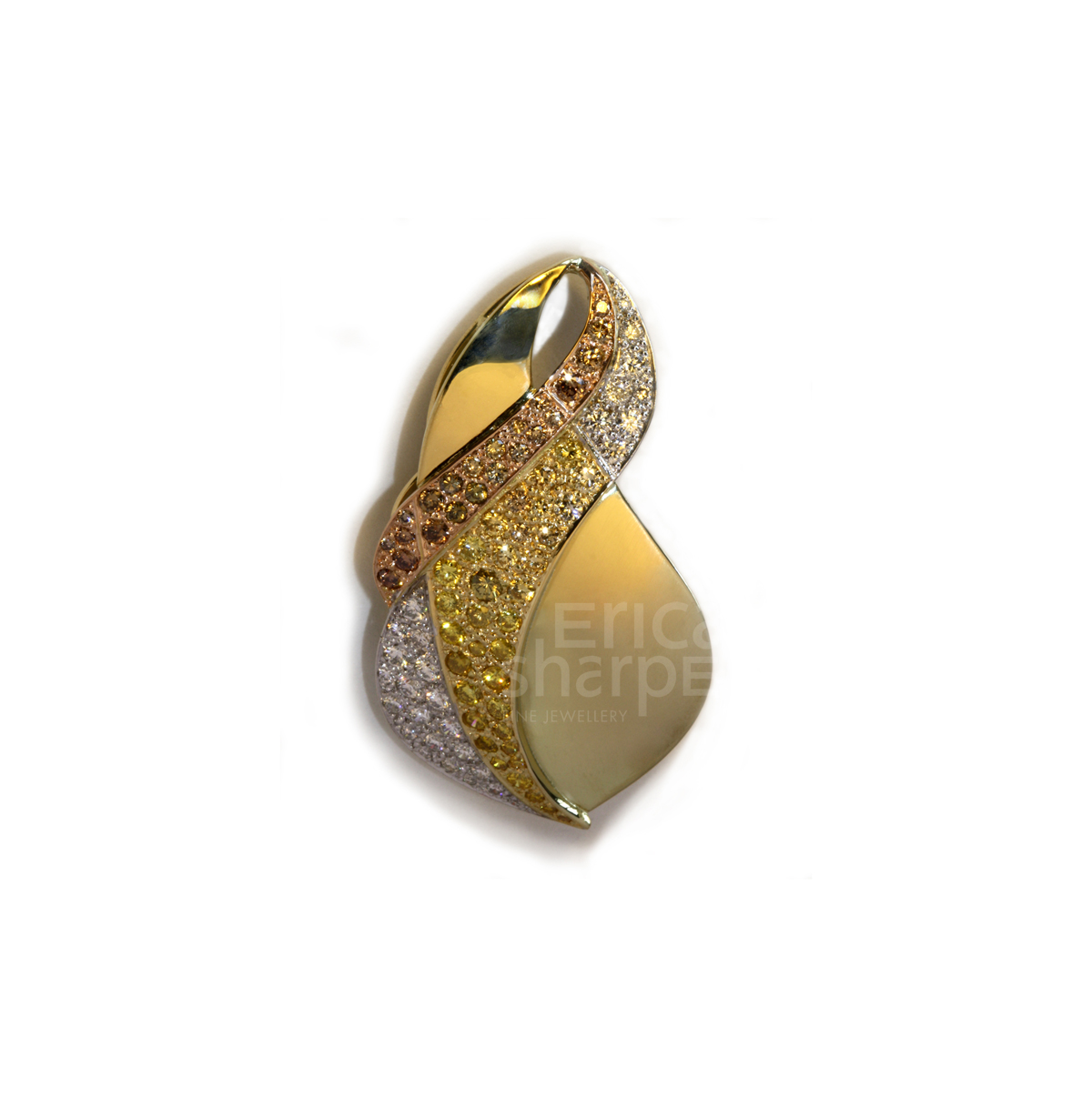
Making the Flame Brooch

This was a rather special commission for a high profile event (more of that at the end!). The brief was to design and make a brooch / pendant inspired by the theme of a flame, and incorporate the colours bronze, silver and gold!

I decided to use rose, white and yellow golds - perfect to reflect the colours of bronze, silver and gold. To add strength and gradients to these colours I chose to use coloured diamonds set into the gold panels of the same colour. The diamonds would also add a glittering effect as the piece as it is worn, especially set into rolling curved surfaces, thereby enhancing the flame theme.

I knew all those hours of gazing into the flames of our open fire would pay off one day!


After drawing the design to scale and painting it with watercolour and gouache, I could plan how much gold I needed and get a selection of diamonds to choose from. At this point the cost was confirmed and the commission was confirmed as a 'go-ahead'.


The final watercolour and gouache design, drawn to scale.

Raw materials, 18ct rose, white and yellow golds. Fancy yellow, cognac, champagne and white diamonds.

Good enough to eat! Natural (not treated) coloured diamonds ready for sorting.

Paper to metal. The cutting pattern outline in the foreground, part-made gold flame (coated with wax to adhere the upturned chosen diamonds) and the original sketch behind.

Once I had cut out, curved and soldered the gold panels, the fun of sorting the diamonds for size, and colour gradation, began. It took two days before I was happy the the selection. I then had to transfer each stone onto a waxed paper lay-out of the flame shape so that they remained in the correct sequence!


Piercing the back-holes

Part of the finesse of a fine piece of jewellery is seen in the attention to, and beauty of, detail at every stage. Once I'd drilled the correct size tapered hole for each diamond to sit in, I shaped the back of every hole into a flowing pattern to complement the style of the brooch and give a pleasing pattern to the entire surface.

The brooch with back rail added, awaiting the hinge and catch.

The back rail enables the piece to sit properly onto a garment when worn as a brooch, it allows a natural space for the hinge, pin and catch, but on this piece it also contains a concealed loop so that it can become a pendant by threading a chain through the top. 


The finished result! 

Once the piece had gone up to the London Assay Office for its hallmarks it was set with the 85 diamonds. The style of setting is know as 'Pavé' - French for 'to pave' - the idea being to cover the surface like a stones in a pavement. The diamonds sit down into the tapered holes that I cut, then small grains of gold are raised/ rolled up over them from the edges. They are rounded to form a series of tiny beads which hold the stones in place.


The presentation of each piece is very important to me - to reflect the care and attention to detail that is given to its creation. I wanted to include details which recorded the story and meaning. In this case, the original design, record of its making and technical specification were included in a beautiful bespoke case. 

With Mary Bignal-Rand and Seb Coe at the Olympian dinner, InterContinental Hotel, Park Lane, London.

The icing on the cake was the kind invitation to the Olympian dinner, hosted by Seb Coe and many fellow Olympians, where the flame brooch was auctioned (for the highest bid of the evening!) to raise funds for the Millfield Foundation scholarships and bursaries. It was wonderful to meet some of the world's top athletes and hear their fascinating stories of success.


Follow Erica on Twitter: https://twitter.com/EricaSharpe

Wednesday, 2 May 2012

Diary from the Tinner's Coast


For more about my recent artists residency, where I continue to learn how rock shapes man / man shapes rock, and develop ideas for future designs in Cornish tin and precious metals, follow the link to my 'Diary from the Tinners Coast'.    http://www.ericasharpetinnerscoast.blogspot.co.uk/